
Pedro Franco*
Many celebrated moral philosophers have defended the role of narrative in our understanding of ethics and the nature of a flourishing life. It seems, so this argument goes, that our grasp of morality grows with the experience of reading narrative artworks, such as novels and tragedies. Notable proponents of this argument are Alasdair MacIntyre, Iris Murdoch or Martha Nussbaum at least in the Anglo-Saxon tradition. Paul Ricoeur also comes to mind. However, not so many philosophers have dedicated their work to the ethical stuff of lyric poetry, or to how we develop morally when attending to (non-narrative) poems. Even within literary criticism, so-called “ethical criticism” is mostly concerned with narrative works of literature (think Wayne Booth). Perhaps this hesitation or absence has been due to a concern with the potential moralism that would easily “mis-shape the beauteous forms of things”, if we were to “murder to dissect.” To be sure, some literary critics and philosophers (e.g., I. A. Richards or Richard Rorty) have attempted this in their own ways, but this has been the exception. In the case of Rorty, even though he was very serious about the moral and cognitive value of poetry[1], his engagement with poems in his philosophical work was neither so frequent nor so central.
The conditions for a philosopher to bring this value to full fruition would require (1) not just using poems as illustrations of ideas or manifestations of moods and (2) explaining that lyric poetry cannot be disconnected from its musical and even corporal aspects and that it surely cannot be reduced to propositional knowledge. I do not believe that Rorty, despite his love (and extended knowledge) of poetry, has done exactly this. However, this comes close to what Taylor sets out to do in his latest book: Cosmic Connections: Poetry in The Age of Disenchantment (2024).
Taylor decides to do this by expanding on his work in the philosophy of language, which he had already developed both in Sources of The Self (1989) and more recently The Language Animal (2016). The latter is explicitly invoked by the author as the “first part” of Cosmic Connections, or rather Cosmic Connections is conceived as the “companion” to read The Language Animal (p. 598). In the first three chapters of the book (Part 1) Taylor lays out the epistemological issues that are raised by poetry, music and their enjoyment, and the different cosmologies (and theories of knowledge) that emerge in Romantic and post-romantic poetry more specifically. The following chapters are extended comments on some key (mostly German and Anglo-Saxon) poets of these periods, intercalated by “explanatory notes,” as the author calls them. The book closes with a reflection on the ethical import of lyric poetry (Part VI). It is a very ambitious combination of history of ideas, literary criticism, and a reflection on the interplay (as usual for Taylor) of social and political philosophy, moral philosophy, the philosophy of art, and philosophy of language.
I should start by commenting on the referred link between Cosmic Connections and The Language Animal. There is something that does not go unnoticed for those who have read the latter: after exploring the role of ritual in human and social life, as something that gives us access to other forms of knowledge, one of the promises that Taylor had made was to expand on how we could better understand the idea of poetry as ritual. In my view, this wasn’t completely fulfilled in Cosmic Connections. Only in the very beginning (p. 19) and towards the end of the book (p. 597) does Taylor say something substantive about this but one finishes the book with the impression that the promise was not entirely kept. We wonder if we are supposed to think of our engagement with poetry (and music?) in an analogy, for instance, with the kind of re-enactment that happens, say, in Catholic liturgy (to use Taylor’s own example), or not.
Instead, Taylor begins his book by revising his proposal of the shift from what he had called (in The Language Animal) the Hobbes-Locke-Condillac (HLC) paradigm to the Hamann-Herder-Humboldt (HHH) paradigm, that is, from a conception of language that is fixed and designative (words are an inventory of signs used to refer to a number of types or tokens) to a creative and complex notion of language (we create new concepts and images with our imagination, and the elements of language, such as words, do not just depend on a designator, but rather on each other). Of course, Taylor wants to develop his post-Romantic approach to art, human life, and the role of poetry (and music) in human life under the sign of the HHH paradigm, and he now adds a new concept: that of “interspaces,” a somewhat slippery concept.
It mostly refers to a way of avoiding the accusation that art is subjective, and therefore meaningless or nonsense, while dodging the temptation to treat it in a merely objectivistic, positivist way (“music is auditory cheesecake” said Steven Pinker, whom Taylor deridingly cites). Interspaces are therefore a space where I am not closed off inside my head nor totally disconnected from the object of my contemplation; that object rather creates new spaces where I can connect with the idea of an ordered world, or the origins of the world and self. Wordsworth’s “Tintern Abbey” is the starting point for this idea. In the style of analytic philosophy, Taylor tries to explain how the objectifying and subjectivistic temptations would be an error by drawing a 2x2 table to make a distinction between human and biological “meanings,” which can be grounded or ungrounded, and which Romantic and post-Romantic art falsify. Taylor, of course, argues that poetry, music, and deep ethical sentiments have “strong” i.e. grounded human meanings (see the table below, which you can find on p. 53), and they are interconnected: there is a moment when Taylor argues that we cannot support things like Human Rights if we do not have the predisposition to admire Beethoven’s ninth (p. 16). Those predispositions are coextensive, he suggests.
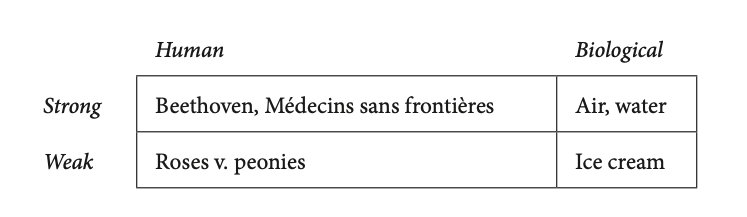
Fig. 1: Taylor’s grid of human and biological meanings, grounded (“strong”) and ungrounded (“weak”). See p. 53 of Cosmic Connections.
However, how exactly we can ground such meanings is not entirely clear in Taylor’s own explanation, or at least the explanation has escaped my attention. One way to solve this would be to say something like: we might believe that poetry, like music, has set standards of excellence, in analogy with the standards of morality. We can only understand such standards and truly enjoy poetry and music if we engage with the practice and learn such standards with the community of practitioners. An argument of this nature (which is famously proposed by Alasdair MacIntyre’s After Virtue) could also explain Taylor’s analogy with the grounded nature of moral, humanitarian sentiment with aesthetic sophistication, in a way that avoids the accusations of the kind “Romantic music was the official art of the Third Reich.” Yet, the issue of motivation is not solved. How can we appeal to the value of such intrinsic goods if we have not experimented ourselves?
In this sense, it is quite interesting that, in these first few chapters, undoubtedly the most interesting ones for philosophers, Taylor addresses an imaginary reader that might be materialistic/reductionist who believes humans and human phenomena can be reduced to biological compounds and processes, respectively. The question is: why does he do this? Either he is preaching to the choir, or he is trying to persuade the majority of us, positivists, non-readers of poetry (and potentially, his fellow philosophers) about the ethical and aesthetic values of verse. Adam Gopnik, in his review of this book, has noted that this might not be very effective. However, the conceptual distinctions are still useful for those of us who often need to show, at least, that the “objective/subjective” dichotomy is a false one when we address questions about art and standards of taste and morality.
Now, a lot has been said about Taylor’s selection of poems that he comments on: how it seems to be directed to make a case about the role of religion in resisting the worst consequences of the disenchantment of the world (he closes his anthology with the likes of T. S. Eliot and Miłosz, a Catholic Polish poet) or how he underestimated the more “cerebral” or rationalistic aspects of what some of these poets believed in (regarding this issue, I would point again to Adam Gopnik’s review, but also that of Stephen Mulhall in the London Review of Books). For this reason, I would like to note a few ideas that I haven’t found in other reviews about this book and that might seem collateral to its content. I’ll try to prove they are not. The first has to do with Taylor’s philosophical prose, his writing style. It resembles the kind of reasoning that Taylor himself describes in an interview on education, where he recalls the lecturing style of his professor of philosophy of religion from his undergraduate years:
There was a magnificent teacher when I was an undergraduate at McGill, who was giving a course in comparative religion that I wanted to take because I thought it was interesting. This teacher changed my life. He is quite well known: Wilfred Cantwell Smith. … he did not really have a charismatic way of speaking. He would often just walk up and down and mumble a bit to himself. However, he managed to evoke for us what it was like to be a Hindu, a Buddhist or a Muslim, in a really extraordinary fashion. … He was obviously straining to understand something and get it across. He would correct himself and say: “Well, maybe that was not quite understandable or striking.” It was not a wonderful flow. … You could just feel him reaching out to get at what was difficult and somehow make you see it.[2]
This professor made such an impression on Taylor that it really seems that he is describing his own way of philosophizing today. In this book, this way of exposing an argument is even more blatant: Taylor says something, he goes on an excursus, seems uncertain of his own thought process and then, sometimes unexpectedly, arrives at a new conclusion, oftentimes to refine or redefine the fundamental concepts of his own argument. For example, he tries to qualify the aforementioned concept of “interspace” several times throughout the book. What many philosophers might view as a vice, Taylor views as an inevitability if we don’t want to impoverish our understanding of difficult concepts and intuitions. Although this might be viewed as a sign of intellectual honesty (and patience), it also makes the book difficult to read. Furthermore, the fact that Taylor really cherishes the poems he quotes makes it difficult to follow his general argument; he himself explains that much of this book is the collection of notes of years of reflection on the topic; and although this is a challenging task (we should not forget that Taylor wrote this book at age 92), the editorial work could have played a more significant role here.[3]
The second thing to be noted has to do with “self-doubt” and “uncertainty”, words that stand out in the acknowledgments section of this book, and which often mark the way Taylor lays out his arguments throughout. This might have an epistemological meaning, much in line with Taylor’s own position about what we can and cannot know. Now it’s not just a sign of intellectual honesty, but rather epistemic humility. In a book about the value of poetry in a human life, this can only be a coherent gesture with what he is trying to say: he is not a positivist, he does not believe that philosophy can allows us to achieve all relevant knowledge for a flourishing human life.
Both these aspects of Taylor’s writing style connect in that attempting to understand something as elusive as “interspaces” of post-Romantic poetry could not be done in any other way than by exploration, trial and error, excursus, and self-doubt. In a sense, it seems that philosophising about this is itself poetic work. Throughout the book, we have a clear example of how the boundaries between philosophy and poetry, post-Romantic poetry at least, as conceived by Taylor, are erased, as Stephen Mulhall proposed in his review of the book. However, unlike Mulhall I do not believe that this is a failure. Since Mulhall describes Taylor in this book as a covert philosopher disguised as an amateur literary critic, I see the book as a statement about the difficulty of separating the two disciplines. In short, Taylor argues that poetry allows us to access truths that propositional knowledge cannot give us; so perhaps his gesture of spending lots of pages just citing and commenting on great poetry from Romanticism and Post-Romanticism, and his constant refinement of the terms that are important to him, are precisely an argument in and of itself.
[1] Where Rorty discusses this value in more depth is in Philosophy as Cultural Politics (2007), which he wrote about the same time as his short text “The Fire of Life” (2007, full text available in Poetry Foundation’s website). In the latter text, however, Rorty is clear that “the distinction between prose and verse was irrelevant to my philosophical purposes.” He does engage with poems in earlier, though, for instance, in the opening of Contingency, Irony, Solidarity (1989)
[2] In Jens Beljan, Johannes Drerup, and Charles Taylor, 2020, “Culture, Identity and Education” in Charles Taylor – Perspektiven der Erziehungs- und Bildungsphilosophie, Nicole Balzer / Jens Beljan / Johannes Drerup (ed.), mentis Verlag, pp. 34-35.
[3] There are numerous editorial problems which make the work of the reader much harder, as noted by several reviewers which I can also attest: unfinished and pithy sentences, repeated citations with only two or three pages a distance, and so on.
*Postdoctoral researcher funded by Universidade Católica Portuguesa / Porticus (GR-074770). Centro de Investigação do Instituto de Estudos Políticos, Universidade Católica Portuguesa. Email: pefranco@ucp.pt
REFERÊNCIA:
Charles Taylor. Cosmic Connections: Poetry in The Age of Disenchantment. Cambridge, MA: Harvard University Press, 2024.